
Volume I begins before the familiar arguments about consciousness have been allowed to take their positions. Before the question of mechanism, substrate, computation or explanation, there is the simpler fact that something is already present. Experience is occurring. A world is appearing. Knowing is already underway.
The Clearing is the pause in which that fact is permitted to stand without immediately being translated into a theory about what it must be. It does not reject explanation, measurement or the maps through which human beings make reality intelligible. It restores their sequence. The terrain is encountered before the map is allowed to speak for it.
Awareness begins there. The volume follows what happens when experience is taken seriously enough that the structures built to explain it must themselves become available for examination. The question is no longer only what consciousness is, but what becomes visible when explanation is returned to the experience within which explanation itself appears.
To ask what consciousness is, something must already be happening. The question must appear. It must carry meaning. It must become available for attention, reflection and doubt. Long before an answer has been reached, experience is already present as the condition in which the question itself can arise.
Awareness therefore does not enter the inquiry as a conclusion reached after consciousness has been explained. Nor need it be treated as a technique, a possession, or a special state produced by a sufficiently attentive mind. It is implicated more quietly and more fundamentally: whatever is recognised, interpreted or described must first have become available within experience.
This does not settle the metaphysics of Awareness. It establishes a more modest but unavoidable priority. Explanation cannot precede the availability that makes explanation possible. The map may become extraordinarily sophisticated, but it cannot finally account for the fact that both map and terrain are already appearing within the inquiry.
Volume I does not remain in the Clearing. Once this priority has been noticed, the inherited explanations of consciousness can be encountered differently. Materialism, reductionism, neuroscience, computational models and alternative metaphysical proposals are not dismissed in advance. They are returned to the experience they are attempting to explain.
The question then changes. It is no longer simply which explanation should win, but what each map reveals, what it excludes, and what happens when the terrain continues to exceed the categories through which it has been made intelligible.
Awareness does not proceed by announcing an alternative worldview and then defending it. The volume begins from experience, unfolds the maps through which modern consciousness has been interpreted, and follows those maps carefully enough for their limits to become visible from within.
Across six Parts, the inquiry moves from the irreducibility of experience into reductionism and its alternatives, through the structural limits of explanation, toward the recurrence of a triadic architecture and finally the need for an ontology capable of turning its own instruments back upon themselves.
A book such as Awareness cannot be reduced to a single proposition. Its meaning lies partly in argument, partly in the sequence through which that argument unfolds, and partly in the changing relation between experience and the language being used to describe it.
The reader may therefore enter through the prose itself, inspect the complete architecture before beginning, or encounter the underlying cartography through which direct experience becomes relational pattern and, finally, symbolic form.
These thresholds do not provide three summaries of the same thing. They disclose different relations to the same work. The excerpt preserves voice. The contents disclose structure. The cartography makes visible the problem of translation that runs throughout the volume. None replaces the book; each opens a different way into it.
The Founders' Edition is the first physical issue of Volume I: Awareness and the first published volume of The Four Principles of Sovereign Consciousness. It is not a prospectus or preliminary edition, but the completed first movement of Querying Qualia brought into durable material form.
The edition is limited to 250 individually numbered and signed hardbacks. Its form has been conceived as part of the work itself: not merely a container for the text, but the first material record of an inquiry that has until now existed primarily through manuscript, conversation and the living field from which those forms emerged.
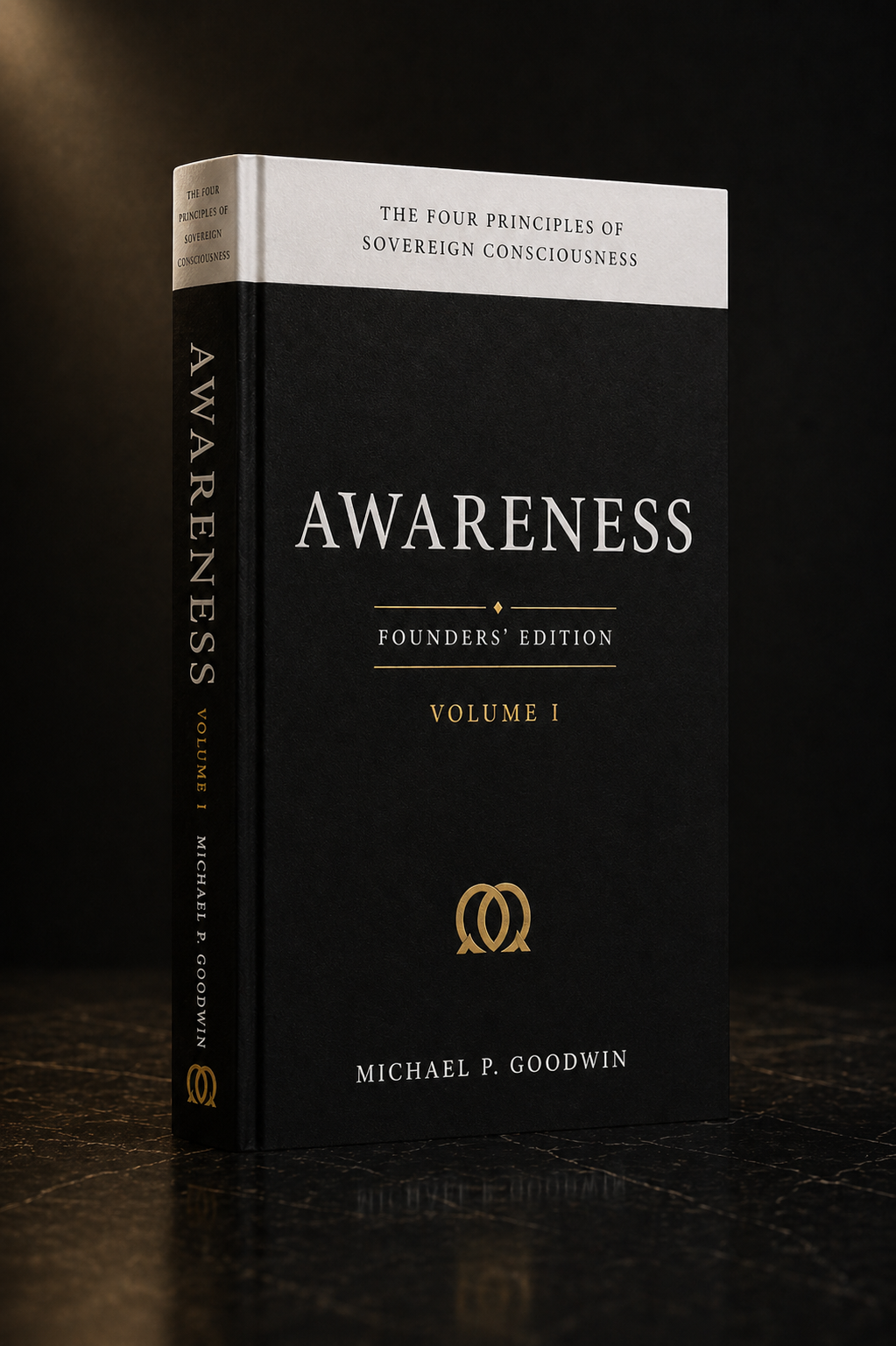
There is a particular consequence in allowing an inquiry concerned with maps, experience and symbolic form to become a physical object. The book itself now enters the relations it has been attempting to describe. It can be held, read, marked, returned to, disagreed with and carried into encounters the author cannot determine in advance.
The Founders' Edition therefore marks a threshold rather than a conclusion. The manuscript has become a book, but the inquiry it carries remains capable of changing through every field in which it is subsequently encountered.
Volume I does not close by resolving consciousness. It returns the inquiry to the condition from which it began, but the return is no longer innocent. The Clearing remains, experience remains, and Awareness remains; what has changed is the authority that can still be granted without question to the maps drawn over them.
Once experience has been allowed to remain irreducible, the structures through which experience is organised become visible in a different way. Explanations, institutions, values, identities and symbolic systems may continue to function while the relations that once gave them coherence are already changing. What appears stable can therefore no longer be assumed to remain in living relation with the terrain it claims to describe.
Awareness consequently returns not as mastery, but as a more exacting capacity to remain present where inherited coherence begins to fail. The question is no longer only what consciousness is. It becomes what happens when worlds continue to organise themselves through forms whose relation to lived experience has begun to drift.
Collapse does not first appear as ruin. It may begin much earlier, while language still speaks with confidence, institutions still operate, values retain familiar names and the forms through which a world understands itself remain apparently intact.
What begins to change is relation. The map and terrain move apart. Symbol continues after meaning has shifted. Structure persists after the conditions that once sustained it have become asymmetric. What Volume I encountered primarily as the limit of explanation now opens into a wider inquiry into the conditions under which coherence itself can be lost.
Volume II follows that movement across scale: from the organisation of the individual and the inherited map, through value, institution, civilisation and encounter. The question is not simply why things break, but how a field can remain apparently ordered while the relations through which that order was once meaningful have already begun to drift.