
We usually recognise collapse too late. We see it when the institution fails, when the relationship breaks, when the economy contracts, when the civilisation fractures, when the body can no longer carry what has been demanded of it. By then the event has become visible because the form that concealed it can no longer be maintained.
Yet the deeper movement may have begun long before. A relationship can continue after its relational coherence has begun to withdraw. An institution can retain authority after the purpose that once gave that authority meaning has drifted. A culture can reproduce its symbols, values and explanations with increasing intensity while the living relations beneath those forms are becoming progressively less capable of carrying them.
Collapse, in this sense, is not first an event of destruction. It is a changing relation between form and the field of relations through which that form remains viable. What is visible may persist. What is named may remain familiar. The structure may even become more active, more elaborate and more determined to preserve itself. And still, something essential in the relation may already have begun to move.
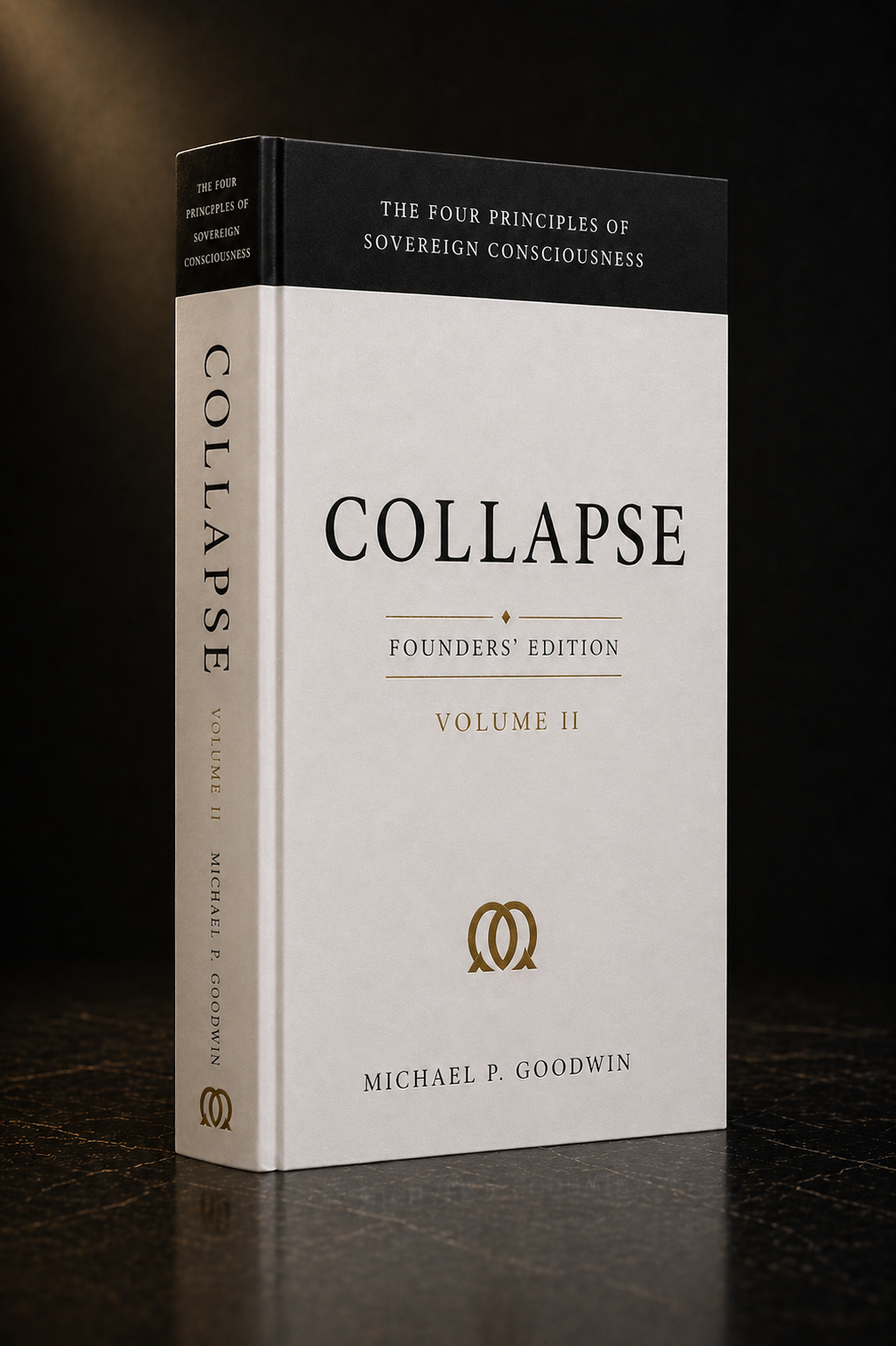
Volume II begins inside that interval. It asks how coherence weakens before disappearance, how inherited structures remain persuasive after their conditions have altered, and how a field can continue to appear ordered while the relations through which that order once carried meaning have become increasingly asymmetric.
Awareness returned explanation to the experience from which explanation arose. Collapse follows the consequence of that return. Once the map can no longer be treated as more authoritative than the terrain, the relations sustaining the map themselves become available for inquiry.
The question therefore changes again. It is no longer merely whether a structure works, survives or remains internally consistent. The question becomes what kind of relation is required to keep it standing, what must be excluded or neutralised for that continuity to be preserved, and whether the form still remains answerable to the field from which it once acquired coherence.
There is a moment in the life of a structure when coherence and continuity begin to separate. What once held because its relations were sufficiently alive, reciprocal and responsive must increasingly be held through repetition, enforcement, explanation or control. From the outside, the structure may appear more organised than before. From within, however, a greater proportion of its energy is being used simply to prevent the consequences of relational change from becoming visible.
This is one of the difficulties of recognising Collapse while it is occurring. We expect disorder and encounter intensification. Rules multiply. Explanations become more elaborate. Boundaries harden. Dissent acquires disproportionate significance because disagreement is no longer encountered merely as difference; it begins to threaten the coherence of the structure through which difference is being interpreted.
What appears to be increasing coherence may therefore be something else: the conversion of relation into closure. The structure no longer remains stable because it can receive what exceeds its present form. It remains stable by reducing, excluding or reinterpreting what cannot easily be made to conform.
Ontic Drift names part of this movement: the growing distance between a structure and the living relations through which that structure acquired meaning. The difficulty is that drift does not require the vocabulary of the structure to disappear. The same words may continue to be used. The same values may still be professed. The same rituals, categories and explanations may remain visibly intact.
What changes may be less obvious than vocabulary. The grammar changes. Relation becomes management. Reciprocity becomes compliance. Orientation becomes instruction. Inquiry becomes confirmation. The structure can therefore appear recognisably itself even after the manner in which it participates has begun to become something else.
Volume II follows Collapse through three Atlases, but they are not three separate catalogues of dysfunction. Each carries the same ontological pressure into a different register. The first asks what happens when relation contracts toward singular authority. The second asks what happens when relation is translated into measure, exchange and instrumental worth. The third brings both movements back toward the scale at which they are lived.
The movement is therefore one of decreasing distance. The One can initially be encountered through history, sovereignty, ideology and institution. Value can be traced through economy, labour, exchange and the abstraction of worth. Encounter becomes more difficult to hold at arm's length because the same grammar begins appearing in groups, relationships, language, interpretation and eventually within the act of interpretation itself.
The Atlas of the One traces the concentration of authority across political, theological, historical and institutional forms. Its concern is not simply the existence of rulers or centralised systems, but the recurrent movement through which one principle, interpretation or organising centre becomes sufficiently privileged that plurality must increasingly answer to it.
The One therefore does not belong only to monarchy, ideology or state power. Those are large-scale manifestations of a more general contraction: relation is simplified until coherence is sought through singularity rather than sustained through reciprocity.
What appears as unity may then depend upon the progressive narrowing of what the structure is able to receive.
The Atlas of Value descends beneath overt authority into the architecture that allows authority to persist through duration. Every structure must decide what counts, what matters, what may be exchanged, what may be consumed and what can be treated as expendable.
Value therefore exceeds economics. The deeper movement concerns the abstraction of relation into quantity, outcome, utility and measure. Meaning becomes price. Relation becomes resource. Time becomes allocation. Living beings can become increasingly legible through what they produce rather than through the relations they inhabit.
The sovereign does not stand without the ledger. Authority and valuation emerge as two expressions of the same narrowing field.
The Atlas of Encounter carries the grammar of Collapse downward through scale. The One is no longer only sovereign, state or institution. It can appear wherever one interpretation becomes sufficiently privileged that experience must pass through it before being regarded as legitimate. Value is no longer only money. It can appear wherever one preferred outcome becomes sufficiently important that the beings and relations through which it is pursued become instrumental to its production.
Collapse then becomes available in groups, interpersonal relations, language, trust, self-regulation and the categories through which an encounter is interpreted. The movement is increasingly intimate because authority need no longer be externally imposed. A governing grammar can be internalised, reproduced through identity, and experienced not as constraint but as integrity.
Encounter therefore changes the function of the Atlas. The reader is no longer being asked only to recognise Ontic Drift elsewhere. The instrument through which recognition occurs must eventually become available to the same inquiry.
The distinction cannot finally rest upon possessing better words. Awareness can become doctrine. Sovereignty can become performance. Responsibility can flow in only one direction. A language of participation can still organise a field in which the encounter is no longer permitted to alter the framework. What matters is whether the structure remains answerable to what actually occurs within it.
Complexity is easily mistaken for size, intricacy or the quantity of information a system is capable of processing. Volume II approaches the question differently. A structure may be extraordinarily sophisticated and still possess very little capacity to be altered by what it did not anticipate.
The more consequential question is relational. What happens when difference enters the field? What happens when experience does not conform to the available categories, when an outcome cannot be predicted, when a participant refuses the expected role, or when the terrain produces information the existing map cannot comfortably contain?
Ontological viability concerns the capacity of a structure to remain coherent in the presence of such asymmetry without reducing the disturbance merely to error, threat or noise. Collapse becomes more likely where continuity depends upon preventing the encounter from changing the form through which it is being interpreted.
That architecture is not intended as a conventional hierarchy of complexity or a ladder of progress. It examines different relational capacities through the manner in which structures encounter uncertainty, difference, turbulence and novelty.
The full model belongs within the sustained inquiry of Volume II. Here, the essential orientation is sufficient: the viability of a structure is disclosed less by how orderly it appears than by what happens when something enters the field that the existing order did not know how to contain.
The earlier movements of Volume II can still tempt the reader into a familiar position. Authority can be located in governments, institutions or ideologies. Value can be located in economic systems, organisational cultures or forms of exchange. Collapse appears as something that happens elsewhere, within structures sufficiently distant that they can be examined without the examiner becoming part of the account.
Encounter removes that comfort. The same movements become visible at progressively smaller scales: within families, partnerships, groups, conversations, expectations and acts of interpretation. The One may appear wherever one account of an event becomes sufficiently privileged that every other account must be translated through it. Value may appear wherever one desired result becomes sufficiently dominant that the relation itself is made subordinate to producing it.
At that point Collapse can no longer be described adequately as the pathology of external systems. The question reaches the participant. It reaches the categories through which experience is recognised, the identities through which meaning is defended, and eventually the ontology through which Collapse itself has become visible.
This is where Volume II begins to place pressure upon Querying Qualia itself. The vocabulary of Awareness, relation, coherence, sovereignty or the Living Field offers no immunity from the structures those terms were developed to illuminate. A language of participation can itself become non-participatory if experience is permitted to enter only after it has already been translated into the language the framework expects.
The safeguard cannot therefore be located in possessing the correct terminology. It must remain grammatical. Does the inquiry still permit encounter to place pressure upon its categories? Can its own distinctions be revised? Can the map itself be changed by the terrain it claims to serve? If not, the ontology may have preserved its vocabulary while reproducing precisely the closure it has learned to diagnose elsewhere.
This changes the posture of Volume II. Collapse can no longer remain a theory through which one person diagnoses another person, one culture diagnoses another culture, or one apparently coherent field stands outside an incoherent one. Every diagnosis is itself an encounter occurring within relation.
The deeper discipline is therefore not certainty about where Collapse resides, but a sustained willingness to allow the instrument of recognition to remain answerable to what it encounters. The Atlas becomes recursive at precisely the moment the cartographer can no longer pretend to stand outside the terrain.
Volume II has acquired substantial architecture, but it has not yet reached the condition in which that architecture can be treated as final. The Atlas of the One and the Atlas of Value have each reached provisional coherence. Their present forms are being allowed to stand while the Atlas of Encounter develops on its own terms.
That sequence matters. To return prematurely to the earlier Atlases and revise them through discoveries still emerging within Encounter would make the later inquiry determine the earlier work before its own grammar had become sufficiently clear. The manuscript would gain consistency at the possible cost of coherence.
The present task is therefore not to make Volume II look finished. It is to allow the unfinished relation to remain visible long enough for the architecture it requires to disclose itself.
The Introduction, the Atlas of the One, the Atlas of Value, the deeper model of ontological viability and the Atlas of Encounter can then be read again as one continuous field. Earlier movements may need revision. Some preparations may prove insufficient. Some claims may have arrived too early. Relations that appeared complete may acquire different meaning once the later Atlas has altered the position from which they are encountered.
Such revision will not be undertaken merely to make the manuscript internally uniform. A living inquiry should not erase the traces of its own development simply because later language is more precise. The criterion is not consistency for its own sake. The criterion is coherence.
Collapse began by asking what happens when structures cease to remain open in the presence of asymmetry. The inquiry has now reached the point at which that question can no longer be directed only toward civilisation, institution or ideology. The structure through which the question is asked has entered the field of inquiry.
What remains is not the completion of a diagnostic map, but the discipline of allowing relation to continue informing what the map can become. The Atlas of Encounter is presently where that work is taking place.